Showing posts with label Exhibit. Show all posts

Wednesday, May 14, 2025

"Streamlined II" highlights the enduring legacy of National Artist Arturo Luz


Renaissance Art Gallery proudly presents the second iteration of Streamlined: The Art of National Artist Arturo Luz at the Art Center, SM Megamall. Curated by artist-critic Cid Reyes, the Streamlined II exhibition showcases Luz's rich and enduring legacy, highlighting his unwavering commitment to impeccable design and disciplined use of color.

In 1951, distinguished art and literary critic Recaredo Demetillo noted, “I must draw attention to the work of Arturo Rogerio Luz. His forms are alive and distinguished; he understands abstraction and austerity, the sense of space and balance. He distorts with intuitive rightness and grace. In other words, he is a real artist.”

Performers

At just 17 years old, Luz, declared National Artist in 1997, was already exploring painting and was drawn to form's simplicity and essential nature. His first work was a portrait of his mother, the renowned interior designer Rosario Dimayuga Luz. As a figurative painter, Luz was inspired by Mexican artist Rufino Tamayo, known for his spare and elongated forms. This influence led Luz to develop his own vocabulary of shapes using plastic lines. He also drew significant inspiration from Swiss artist Paul Klee, who famously described line as “taking a dot for a walk.” This inspiration culminated in Luz's linear depictions of cyclists, musicians, and carnival performers, including acrobats and jugglers, as well as still lifes featuring boxes, Oriental ceramics, jars, bowls, and shells.

Performers

By limiting his choice of subjects, Luz could delve into the elegance of visual simplicity, precision, and spatial balance. He began to favor non-traditional materials such as burlap and laminated plywood, and at one point even used broken tiles to create a mosaic for a church altar floor.

Forms of Amusement

Eventually, Luz transitioned to pure abstraction through collage, which compelled him to create compositions without representational subjects. This allowed him to focus on the planar qualities of form and surface and the visual tension that arises from achieving a perfectly balanced composition.

Women

In the early 1980s, Luz expanded his subject by traveling throughout Asia and India. His experiences during this pilgrimage inspired many works that featured imaginary landscapes filled with temples, palaces, fortifications, and battlements — all transformed into linear symphonies of monochromatic tones accented by earthy colors like chrome yellow, dark mustard, cardinal red, burnt sienna, bronze, and brown.

Borobudur

Arturo Luz also demonstrated his administrative skills in the 1980s by managing his eponymous Luz Gallery, the Museum of Philippine Art, the Metropolitan Museum, and the Design Center of the Philippines.

Of paramount significance is Luz's transformation of the native artistic sensibility from festive and flamboyant to restrained and dispassionate.

Desert Architecture

A limited edition monograph with design and layout by Dopy Doplon and photography by Wig Tysmans will be available to accompany the exhibit.

Streamlined II runs from June 3 until June 16 at the Art Center, SM Megamall, 4/F Bldg. A at the corner of EDSA and Julia Vargas Avenue, Mandaluyong City, Metro Manila.

Palitana White Temples

Facebook: Renaissance Art Gallery
#renaissanceartph
#renaissanceartgallery

Thursday, January 30, 2025

Instituto Cervantes holds a photo exhibit on iconic Spanish wineries


Wine lovers, architecture enthusiasts, and culture aficionados will gather for the highly anticipated exhibition, Wine and Architecture: Wine Tourism Routes in Spain. The exhibit is currently open at Instituto Cervantes in Intramuros.

This exhibit, curated by Belén García-Noblejas, offers a unique exploration of the symbiotic relationship between winemaking and architectural design in Spain. This relationship is a vibrant testament of how two distinct artistic expressions can converge and enrich each other in order to create a unique sensory and cultural experience.


The link between architecture and wine is intensifying with the rise of wine tourism. The wineries are no longer just places of production, but also cultural and tourist destinations. This has prompted the evolution of winery architecture towards the creation of spaces that captivate, educate and entertain visitors.

Visitors of this exhibit will discover how architecture and wine culture intertwine, exploring innovative designs that reflect both the natural beauty of the land and the evolving demands of modern viticulture. With stunning visual photography and the arquitecturals models of three of the most emblematic wineries, the exhibit offers a one-of-a-kind journey through some of the most famous vineyards in Spain. The architecture of the wineries is a tangible manifestation of the passion and commitment of the winemaker, and the fusion of design, functionality and aesthetics create a lasting legacy that, like fine wine, transcends time.

Hotel Marques de Riscal
Photo Quim Roser

The Embassy of Spain in the Philippines, in collaboration with the Tourism Office of Spain, the Spanish Agency for Cooperation and the Instituto Cervantes in Manila, presents this exhibition that shows, from an architectural point of view, the main and most iconic recently built wineries in Spain: Protos, Perelada, Ysios, La Mejorada, Celler Brugarol, Marqués de Riscal and Portia.

The Wine and Architecture Exhibit will run until the 31st of March, 2025. Likewise, within the framework of the exhibition, on February 21st there will be an event including a talk on the theme of the exhibition, a glass of wine for attendees and a classical guitar concert by the virtuoso Spanish musician Miguel Trápaga.

For more information about the exhibit please visit

Thursday, March 07, 2024

Instituto Cervantes opens an exhibit on Nebrija, the grammarian who helped to preserve the Filipino vernacular languages


Did you know that Tagalog had its first grammar published before English did? The linguistic milestone can be greatly credited to the Spaniard known as Nebrija, who played a pivotal role in that development. On March 12, Instituto Cervantes will unveil at its Intramuros branch the exhibition
Nebrija en Filipinas, dedicated to celebrating the cultural contributions of Spanish grammarian Elio Antonio de Nebrija (1444-1522). Nebrija's impactful legacy extends to languages like Tagalog and Cebuano, which possessed grammars ahead of many European languages.

Nebrija en Filipinas, tailored for Filipino audiences, is an adaptation of the Nebrija exhibition organized by the National Library of Spain in 2022, commemorating the 500th anniversary of Nebrija's death. Through informative panels and displays of books, the exhibition will highlight Nebrija’s cultural contributions and seek to contextualize them within the publication of the first grammars of the Philippine vernacular languages. These linguistic endeavours were directly shaped by Nebrija's teachings.

Grammatica Nebrissensis

Nebrija was a highly reputed scholar during the Renaissance period in Europe. His book Introductiones Latinae, a groundbreaking manual for teaching Latin, not only earned him recognition in Spain but also garnered international fame. He also wrote bilingual dictionaries in Latin-Spanish and a Gramática de la lengua castellana, published in 1492, which is recognized as the first grammar of modern European languages. It became the model for Spanish friars who attempted analyzing the grammars of the new world, both in America and the Philippines. These missionaries, who had learned Latin from Nebrija’s methods, applied the model, with its theoretical considerations and bilingual translations, in their description of these languages. As a result, Tagalog saw its first grammar book published in 1610 with Francisco Blancas de San José's Arte y reglas de la lengua tagala. It was followed by similar initiatives with other vernacular languages, among them the Arte de la lengua iloca, composed by the Agustinian Francisco López in 1627, and the Arte de la lengua bisaya de la provincia de Leyte, written by the jesuist Domingo Ezguerra in 1663.

Vocabulario de la lengua Bicol

Proud, intelligent, and audacious, Nebrija was a stalwart fighter for pure Latin and always wanted to go down in posterity with the nickname grammaticus (grammarian). When he presented a preview of what would later become his Grammar of the Castilian Language to Queen Isabel la Católica, the sovereign was initially surprised, unable to grasp the utility of a treatise teaching the rules of a language acquired naturally. However, Nebrija successfully persuaded her that languages benefit from both descriptive and normative grammars to prevent them from running amok. The paradoxes of fate have made his Castilian grammar his most renowned work today. Nevertheless, Nebrija deserves to be remembered for many other reasons.

Arte de la lengua bisaya de la provincia de Leyte

For Nebrija, the revival of Latin was an incentive for other scholarly pursuits. The voyages of the discoverers aroused his curiosity, leading to a fascination with cosmography and a desire to learn about developments from across the Atlantic. In these and other scholarly ventures, Nebrija revealed himself as a full-fledged humanist.

Tagalysmo Elucidado

Even after his death, Nebrija’s fame did not diminish. His grammars and lexicons were not only published in Spain but also gained recognition in France, Italy, Germany, and the Netherlands. The Latin manual he had written for his students in Salamanca attained exclusive authorization for teaching the discipline, a decree made by King Philip III in 1598. Nebrija's Latin grammar manual continued to be esteemed, annotated, and adapted based on location and circumstances until the 19th century.

Arte de la lengua bisaya-hiligayna de la Isla de Panay

The exhibit Nebrija en Filipinas, which will run from 12 March to 12 June, 2024, is organized by Instituto Cervantes in collaboration with Fundación Antonio Nebrija (Madrid), the Embassy of Spain and AECID, Biblioteca Nacional de España, and the University of Sto. Tomas (Manila). Nebrija en Filipinas is an adaptation of the original exhibit Nebrija, curated by Dr. Teresa Jiménez Calvente, with addition of panels focused on the Philippines composed by Marlon James Sales, of UP Diliman. The exhibit will have a second leg from August to October in the Miguel Benavides Library of UST.

For further information about the cultural program of Instituto Cervantes de Manila, please visit their website (https://manila.cervantes.es), or follow Instituto Cervantes on the following social media pages: (Facebook: InstitutoCervantesManila; Instagram: institutocervantesmanila).

Sunday, February 18, 2024

Qube Gallery, Eskinita Art Farm unveils Cross Currents exhibit at AFM


Cross Currents
, an exhibit that invites viewers to explore the complexities of cultural exchange and artistic evolution, emphasizing the significant impact of such fusion in the art world, recently opened at the Alliance française de Manille 10 days before the highly anticipated Art Fair Philippines.


Presented by the Alliance française de Manille, in collaboration with Qube Gallery and Eskinita Art Farm, Cross Currents follows Qube Gallery's successful Under the Same Southern Sky exhibit, also at the AFM back in 2023.


The exhibit is described as highlighting the diverse artistic heritage of the Luzon and Visayas regions and offers a captivating visual narrative that traces the evolution of contemporary art in the Philippines, deeply rooted in cultural history.


Additionally, it showcases Filipino artists’ unique journey, merging Western art movements like classical realism, abstract expressionism, and low-brow street art with local themes and indigenous motifs. The fusion creates a distinctive visual language that asserts a strong national identity while remaining globally relevant.


The exhibition is a celebration of the innovative ways Philippine artists have integrated Western artistic influences, showcasing their ability to create a dynamic, unique artistic identity.


Cross Currents is open for viewing at the Alliançe Francaise de Manille until March 9, 2024.

Friday, October 28, 2022

Marcel Proust's In Search of Lost Time, illustrated by Stéphane Heuet exhibit at Alliance Française de Manille


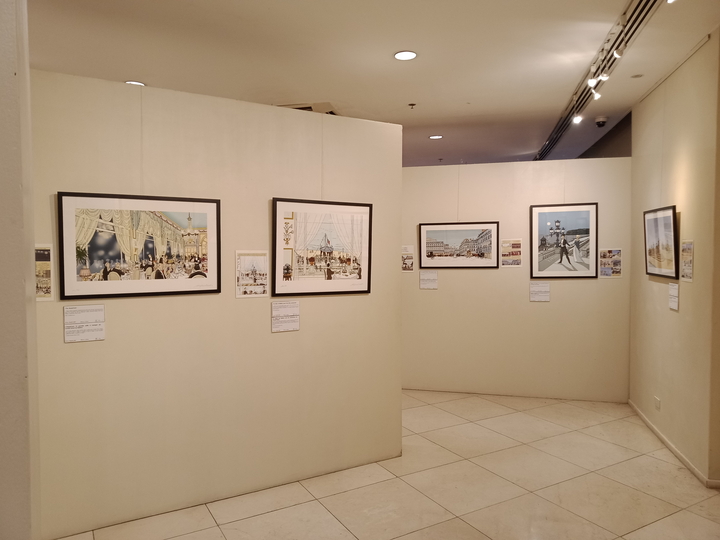
As part of the ongoing 75th Anniversary of the Philippine-French Diplomatic Relations celebrations, the Embassy of France and Alliance Française de Manille present the Marcel Proust: In Search of Lost Time exhibit featuring the illustrations of French artist, Stéphane Heuet, currently ongoing at the Alliance Française de Manille Gallery until October 31, 2022.


Marcel Proust's In Search of Lost Time is the story of author's life told in seven volumes. It is considered as the major work of French fiction of the early 20th century.

Reihane Zitounie, Stéphane Heuet, Ambassador Michèle Boccoz

In adapting Proust's work into a graphic novel, French illustrator Stéphane Heuet has built his drawings as visual transcriptions of the text. He has worked on re-cutting and scripting from passages of the novel in order to reconstitute a narrative that works in comics.


The exhibit features a total of 26 one of a kind and limited edition prints of the illustrations from Heuet's graphic novel adaptation of Proust's novel. The prints on exhibit are for sale.


Compared to American superhero comics or Japanese manga that highlight action sequences, Heuet's illustrations are picturesque scenes, with the human characters having clean, simple lines placed among highly detailed backgrounds, typical of the ligne claire style.


Limited copies of the graphic novels, both in French and in English were available for sale at the exhibit opening but they quickly sold out. Heuet said that the AFM library will have copies of them soon.


Marcel Proust: In Search of Lost Time exhibit, a part of the 75th Anniversary of Philippine-French Diplomatic Relations celebrations, is organized by the Embassy of France to the Philippines, Alliance Française de Manille, sponsored by San Miguel Corporation, Fairmont Makati, Filmloft OPC, and in partnership with Komiket and Philippine International Comics Festival.

Marc Piton, Reihane Zitounie, Ambassador Michèle Boccoz, Stéphane Heuet,
Xavier Leroux, and Pierre Malvache

Affiliate Disclaimer: As an Amazon Associate, this post contains affiliate links. A small commission is earned when purchasing through these links with no additional cost to the consumer.

Swann's Way

In the Shadow of Young Girls in Flower
Place Names: The Place

Friday, January 29, 2021

CCP 2021 Thirteen Artists Awards opens submissions for nominations


The Cultural Center of the Philippines, through its Visual Arts and Museum Division has recently announced that it has started accepting nominations for the 2021 Thirteen Artists Awards.

Art councils, art groups, heads/deans of art schools, museum and gallery curators and directors, art critics, and past Thirteen Artists Awardees may nominate a maximum of three (3) artists each.

Artists submitted for nominations must meet these requirements to be eligible.
  • Body of work characterized by artistic integrity, innovativeness, and forcefulness of ideas
  • Responsiveness to contemporary realities
  • Evidence of sustained artistic activity demonstrated by a track record of individual exhibitions and group shows for at least the past three years
  • Engagement with contemporary visual art forms including, but not limited to, painting, sculpture, new media, installation, performance art, photography, printmaking and digital imaging
  • Filipino citizenship
  • Less than 40 years old in the year of conferment or must be born 1982 onwards
The CCP Visual Arts and Museum Division (VAMD) under the Production and Exhibition Department and the Office of the Artistic Director will convene a Selection Committee composed of four (4) past awardees and the head of the CCP VAMD. The decision of the Selection Committee is final.

The prizes of a Thirteen Artists Awardee include a cash grant to defray the cost of materials for producing new work for a group exhibition at the CCP Bulwagang Juan Luna (Main Gallery), which will open with the formal awarding ceremonies; A trophy designed by a 13 Artists Awardee and specially commissioned for the 2021 Thirteen Artists Awards as well as Participation in CCP’s public programs of discussions, lectures, workshops and other activities.

Since its first presentation 50 years ago, the Thirteen Artists Awards (TAA) started as a curatorial project of the Cultural Center of the Philippines (CCP) Museum under the directorship of its first curator Roberto Chabet. The TAA was created in order to showcase the works of artists who grasped to “restructure, restrengthen and renew artmaking and art thinking…that lend viability to Philippine art”. It was Raymundo Albano, the next Director of the CCP Museum and Non-theater Operations who transformed the 13 Artists into the awards program that it is today. The 13 Artists exhibition was mounted every two years from 1970 to 1980, and again in 1988, 1990, 1992 and 1994. It was revived in 2000, and changed to a triennial format, which it follows until today.

Nomination forms can be downloaded from bit.ly/taa2021nominations and completed nomination forms are to be sent to ccp.thirteenartists@gmail.com no later than March 1, 2021, 11:59 PM. No hardcopy nomination forms will be accepted.

For inquiries, contact the CCP Visual Arts and Museum Division, Production and Exhibition Department at tel. 8832-1125 loc. 1504/1505, mobile phone 0917-603-3809, email ccp.thirteenartists@gmail.com or visit www.culturalcenter.gov.ph and Facebook, Twitter and Instagram @ccpvamd.

Wednesday, April 03, 2019

Poster exhibit showcases 50 years of CCP


Over 200 posters from fifty years of shows, performances, concerts, exhibits, and events held at the Cultural Center of the Philippines are currently on display at the POSTER/ITY: 50 Years of Art and Culture at the CCP exhibit at the Bulwagang Juan Luna (Main Gallery), Pasilyo Guillermo Tolentino (3F Hallway Gallery), Library and Archives, and Buffeteria.


Going through the exhibit might be a trip down memory lane to those who had been with the CCP since the beginning. But for someone like me who only became conscious and aware of the CCP sometime during the mid 1980s, it was more of a journey on how things were back in the past.


Seeing the posters to various concerts throughout the years gave me an idea as to the big names like Van Cliburn, Gray Graffman, and Ravi Shankar  who have already performed in the country before. While some names, like Franco Mannino and Birgit Finnilä, made me search about  them online right after to find out more about them and also what have become of them after all these years. Digging more about Richard Fagan, a pianist who performed here back in 1976, led me to a dead end and he remains a mystery who I would love to solve.


The techniques back then in producing posters limited the number of colors used and  had photos that were flat, monochromatic, and in high contrast. It is in stark contrast to how sharp and detailes photos look like in modern posters that are now constructed digitally. Also interesting to note how sponsors and their respective logos started to creep in the posters at the turn of the century. The exhibit also points out that posters nowadays exist more as digital images to be spread/shared online rather than be printed and actually posted on walls, bulletin boards, etc.


The POSTER/ITY: 50 Years of Art and Culture at the CCP exhibit that is not just for arts, culture, and history buffs, but also for graphic designers as well can be viewed up to May 26, 2019.