Tuesday, January 03, 2017

Jumping into ZOFO's Mosh Pit and the world of 4 Hands, 1 Piano


Whenever a new year begins, I always find myself having an extra spring in my step. This is reflected by the music that I heavily play around this time. And as I welcome 2017, I have ZOFO’s sophomore album Mosh Pit, released by Sono Luminus, currently on heavy rotation. This album may not be a new release but it’s perfect for me to keep the adrenaline pumping hoping that this upbeat mood will last me throughout the year.

The piano duo ZOFO, a shorthand for 20-finger orchestra (ZO=20 and FO=finger orchestra) is made up of Eva-Maria Zimmermann and Keisuke Nakagoshi. With Mosh Pit, the duo featured high energy music of from 20th century American composers like George Gershwin, Conlon Nancarrow, Samuel Barber, John Corigliano, Allen Shawn and Paul Schoenfield. Various dance styles and rhythms ranging from Carribean, blues, tango, boogie, and even rock and roll make this CD more edgy and sensual than the usual classical/romantic piano fare.

George Gershwin’s four hands arrangement of his Cuban Overture was still able to retain the festive Caribbean flavor despite the absence of the percussion instruments highlighted in the orchestral version of the piece. The Sonatina by Conlon Nancarrow is a short highly syncopated piece venturing into blues and ragtime.


Samuel Barber’s Souvenirs, Op. 28, with the different dance in each movement, one couldn’t help but sway to the beat which can be embarrassing to do while aboard the light railway trains. Speaking of trains, the various movements of John Corigliano’s Gazebo Dances and Allen Shawn’s Three Dance Portraits are light, short, and breezy enough to keep me from getting too stressed if ever the train rides get too jam packed. And the moderately fast tempo would keep me going whenever I walk considering that travelling by foot is often times faster than riding something nowadays.


Paul Schoenfield’s Five Days from the Life of a Manic Depressive is the longest piece and the chunky meat of the CD. The music here does not really plunge to the depths of despair as the title suggests. It does skim the surface occasionally but remains triumphant in the end which is what I want my 2017 to be. Overall, high energy abounds in this album but there’s still enough contrasting material as to not make it sound monotonous.


As I listen to the CD, I couldn’t help but imagine how the parts were divided between Eva-Maria and Keisuke. And also how fun and enjoyable it must be to play these pieces. One thing that really fascinates me about four hands performances is how close the two pianists can get. Not only there is physical intimacy, there are also moments of theatricality especially when the hands of both pianists cross to the other’s section. I guess that both really have to like each other to be comfortable playing that close to one another. Because of this, I’ve been trying to think of an extremely dark and aggressive piece in the four hands repertoire. And I’m digging up nothing so far. It would be very difficult to play such a piece with someone that close and such proximity may feel like an invasion of personal space already.

All these thoughts do entice me to one day try to play pieces for four hands. I know that it would take a lot of digging to get my hands on scores of pieces that would catch my fancy. Ultimately, the bigger question is which pianist will be up to the task to sit by my side and play four hands music with one piano.


ZOFO has released four albums to date: Mind Meld, Mosh Pit, Zoforbit: A Space Odyssey, and ZOFO Plays Terry Riley. Their debut album Mind Meld earned them two Grammy Award nominations back in 2013.

Sunday, January 01, 2017

Welcoming 2017 on a high note

Happy New Year everyone! 2016 was indeed music filled and and it definitely helped me get through such a tension filled year. I apologize that updates for the past year had been scarce, there is no excuse for that. But I believe that the arrival of the new year will whip me up back to shape literally and figuratively resulting in more regular updates. To start the 2017 ball rolling, here are just a few music events to look forward to this year.


The remainder of Yoshikazu Fukumura’s debut season with the Philippine Philharmonic Orchestra resumes with violinist Diomedes Saraza, Jr., cellist Renato Lucas, pianist Monique Duphil, and the orchestra’s former music director Olivier Ochanine as the featured guest artists. May there be no more snags this time so that I will finally see Olivier conduct Dmitri Shostakovich's Symphony No. 10 in E minor, Op. 93

Fukumura will also lead the PPO in select Gala performances of Ballet Philippines’ production of Swan Lake which will be running this February 24-March 5, 2017.

The Manila Symphony Orchestra now adds another night and venue for their 2017 gala concerts. Sunday concerts will happen now at the Henry Lee Irwin Theater, located at the Ateneo de Manila University campus in Loyola Heights Quezon City, just a day after the Saturday concerts at the Power Mac Center Spotlight in Circuit, Makati. This is good news for residents from the northern part of Metro Manila who find Makati too far a venue. The additional date also gives avid concertgoers the choice whether to catch the Saturday or the Sunday performance which is a godsend during a concert/event packed weekend. A definite highlight of the MSO’s upcoming season is a performance of Carl Orff’s Carmina Burana this October 7, 2017 at the Meralco Theater that aims to follow in the footsteps of the recent sold out season finale concert that featured Ludwig van Beethoven’s Symphony No. 9 in C major, Op. 120.

For a limited time only, discounted subscription rates of P4000 (Henry Lee Irwin and Meralco Theater package) and P4500 (Power Mac Center Spotlight and Meralco Theater package) are available through info@manilasymphony.com or by calling 523-4712.


Gerard Salonga and the ABS-CBN Philharmonic Orchestra, on the other hand, will be part of Tatlo 3 Nations. 1 Voice. happening this January 14, 2017 at the Theater at Solaire. In this concert, the Ateneo Chamber Singers, led by conductor Jonathan M. Velasco, will be joined by the Gaia Philharmonic Choir from Japan and the SYC Ensemble Singers from Singapore. Gerard hasn't been able to contain his excitement in having Leonard Bernstein's Chichester Psalms included in this concert. Apart from this, Gerard will be shuttling back and forth to Hong Kong as he continues his stint as an Assistant Conductor for the Hong Kong Philharmonic Orchestra under Maestro Jaap van Zweden.


Happening just a few weeks from now is the 60th anniversary staging of Felipe de Leon and Guillermo Tolentino's Noli Me Tangere the Opera at the Cultural Center of the Philippines this January 28-February 3, 2017. New York based events and floral designer Jerry Sibal will be having his directorial debut with this opera. With Sibal also handling the set and costume design duties, it's been said that this production will feature the largest set that the CCP has ever had for an opera.


Three years after taking Manila by storm, Korean soprano Sumi Jo returns for a one night concert this February 7, 2017 at the Meralco Theater. She will be joined once again by collaborating pianist Najib Ismail. I have yet to see what she has in store for this evening but I'll be very pleased if she includes the Academy Award nominated Simple Song #3 in her song lineup.

These are just a few of what's on the horizon this 2017. More details about the concerts listed above and more will be coming in future blog posts. I'll also document in here what I've been listening, watching, reading, learning and playing at the moment. By sharing my experiences and ongoing journey in the world of classical music, I hope that I'll be able to entice more people to watch classical music performances in here.

Thursday, December 08, 2016

Violinist Iskandar Widjaja's passionate display in Philippine debut


While the protest rallies were happening in various parts of the country, I took solace to music as a way to distract my weary self from all the political drama by catching Passion Flight that featured violinist Iskandar Widjaja and pianist Itamar Golan who were both making their Philippine debuts.

Thoughts of the tense political climate took a back seat right away once the opening act, a dozen Suzuki kids, took to the stage for their rendition of Twinkle, Twinkle Variations. And while the intonation was a bit all over the place, there was still cuteness overload with the kids beaming on stage as if they were the main act.

The main acts, Berlin based Iskandar, sporting a recent tan and dressed more like movie star rather than a classical musician and Itamar, looking dapper in a sleek suit quickly eased the audience with an appetizer of a piece, Fritz Kreisler’s Tempo di Minuetto in the style of Pugnani. Then following right after was Cesar Franck’s Sonata in A Major, a large scale work that showed the breadth and depth of Iskandar’s capabilities. Instinctively, I got drawn to the pianist Itamar, who exuded confidence giving me the feeling that he and Iskandar were communicating telepathically and that they will be in sync all throughout the concert.

I finally got to focus on Iskandar as the spotlight was solely on him when he tackled Johann Sebastian Bach’s Chaconne from Violin Partita No. 2 in D minor, BWV 1004. Very commendable was his clarity and consistency making each line and layer sing distinctly and smoothly. In less capable violinists, the result is usually a muddled jumble of notes without any direction. My only gripe with Iskandar’s take was that it had too much attack and it sounded too aggressive.

Refreshed after the interval, the duo gave a more relaxed George Frideric Handel’s Violin Sonata in D Major HWV 371, brilliantly fleshing out the melodies with a bit more restraint compared to that of the pieces of the first half. My most eagerly anticipated moment in this concert was hearing Arvo Pärt’s Spiegel im Spiegel live for the first time. With lights dimmed for a bit of theatrics during this portion, it was hypnotic and haunting to hear such music, sparse on paper and yet so difficult to play effectively. I initially wondered how the audience would react to music that is devoid of any fireworks but the applause that followed soon after just allayed my fears.

And because of this, I admit that I wasn’t able to focus much on the piece that followed, the Fantasie for Violin and Piano in C Major, Op. 131 by Robert Schumann. And through most of this time, my mind was already preparing to hear the final piece that featured the music from George Gershwin’s opera Porgy and Bess.


I was really expecting Jascha Heifetz’ transcription of Porgy and Bess to be performed but hearing the short piano introduction told me that this was not the case. Instead, what I heard was a single movement fantasy work that showcased loads of virtuosic moments from Iskandar that was accompanied by Itamar playing jazzy chords that sounded so deliciously rich. It was only later on that I learned from Iskandar that this piece, the Concert Fantasy on Themes from Porgy and Bess, Op. 19, was actually by Igor Alexandrovich Frolov. I also learned that one violinist who was among the audience was planning to give the Philippine premiere of this piece sometime next year. Too bad for him that Iskandar and Itamar already beat him to it. But I would definitely want to hear this Frolov piece again.

For encores, Iskandar and Itamar performed William Kroll’s Banjo and Fiddle, a highly entertaining piece that had Iskandar plucking the violin as if it was a banjo. This was followed by Pyotr Ilyich Tchaikovksy’s Valse Sentimentale, Op. 51 No. 6 which was a sweet, relaxing way to cap the concert. The concert made me more energized to face the world outside where one cannot escape the tense political climate.


Overall, the first half felt to me that Iskandar pushed too much, too overt, and almost going over the top in both the Franck sonata and the Chaconne. This made the restraint he exhibited at the second half a much welcome change of pace. Ultimately, this effectively built the momentum towards a dazzling finale.

Passion Flight featuring violinist Iskandar Widjaja and pianist Itamar Golan was presented by the Philippine Suzuki Association in cooperation with St. Paul University, Manila.

Monday, November 28, 2016

A grand ball of a choreographic debut for Lisa Macuja-Elizalde in Ballet Manila’s Cinderella


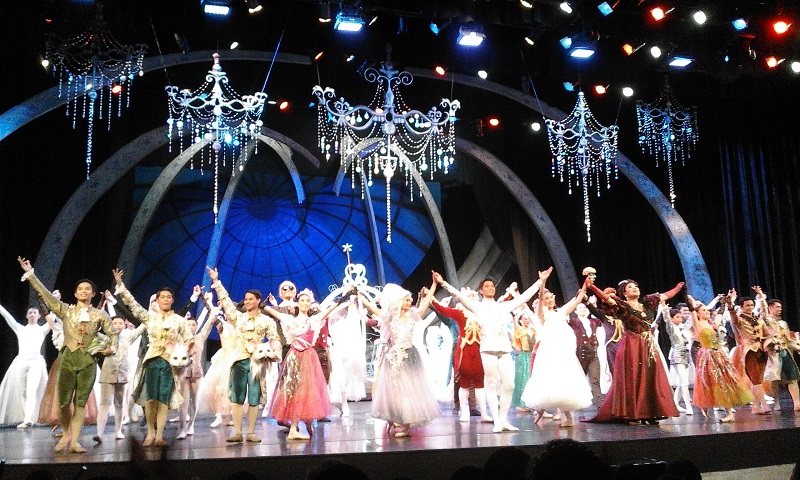
A visually stunning feast and spectacle characterized Ballet Manila’s Cinderella, the major full length choreographic debut of the company’s CEO and co-artistic director Lisa Macuja-Elizalde.

More reminiscent of the Disney animated feature, this new ballet boasted of sets and props by Mio Infante that elicited oohs, aahs and generous applause once they were unveiled. A blink and you miss it quick costume change got me and fellow members of the audience buzzing about it during intermission. And never had I seen a production where a rat on stage was a welcome sight.


But this is still ballet and the dancers are always the stars. Long limbed Abigail Oliveiro exuded softness, innocence, refinement, and a brilliant sense of wonder as Cinderella. Her Prince Charming, Mark Sumaylo, cut a dashing presence on stage with his portrayal of his character’s growth from a carefree lad to a maturing man once love took over. Abigail whipping some fouettes and Mark hitting triple pirouettes reminded me that Ballet Manila’s season wasn’t dubbed as Revenge of the Classics for nothing. Cinderella might be a fairy tale but the dancers still need to display Ballet Manila’s Vaganova method training. While the two’s respective solos were solid and secure, their partner work wasn’t as fluid showing signs that theirs is still a new partnership on stage. But the two’s undeniable chemistry on stage would make the audience suspect that they are indeed a couple off stage (which they are indeed).

Providing comic relief in the ballet are the Step Sisters danced by Tiffany Chiang and Violet Hong. Both ladies are technically strong and it was a breath of fresh air to see them looking and dancing so unrefined befitting their characters. One just had to see Jonathan Janolo as the Step Mother since no word can describe his scene stealing portrayal.

The company’s danseurs had their time in the spotlight as the mischievous animal friends of Cinderella who got transformed into her enchanted escorts to the ball. I wondered how rehearsals went for these danseur with animal their masks on especially during the part where they had to throw and catch a pumpkin prop among themselves. I wouldn’t be surprised if they kept on dropping the pumpkin during their first attempts on catching it.

Probably more challenging than the masks was the towering wig/head dress worn by Lisa Macuja-Elizalde as the Fairy Godmother. She told me after the show that it was more difficult to spot while wearing the wig. Dancing on pointe while carrying an additional weight on her head probably was one of the things that Lisa never imagined doing post retirement.

Prior to seeing the ballet, I was very intrigued as to which music this production would use. Sergei Prokofiev’s score is typically the default music for most Cinderella ballets out there. But for this one by Ballet Manila, the score was a combination of music from various Cinderella productions: the ballet by Sergei Prokofiev, the Disney animated feature with score/songs by Oliver Wallace, Paul J. Smith, Mack David, Jerry Livingston, and Al Hoffman, and the musical by Richard Rodgers and Oscar Hammerstein. All this, plus some original compositions, was made into a cohesive whole by music arranger Roy del Valle.

For almost two hours, Ballet Manila’s Cinderella transported the audience to a magical place making the kids anticipate the upcoming holiday season a lot more. In my case, it was a wonderful way of escaping the current tense political climate that I wish that I could’ve stayed at the ball even after the clock struck midnight.