Tuesday, October 08, 2013

MSO IV: Verdi’s Opera Extravaganza

Tanya Corcuera, Noel Azcona, Camille Lopez-Molina, Nomher Nival
and Myramae Meneses

Featuring:
Camille Lopez-Molina, soprano
Noel Azcona, baritone
Myramae Meneses, soprano
Tanya Corcuera, soprano
Nomher Nival, tenor
Viva Voce
Manila Symphony Orchestra
Arturo Molina, conductor

Programme:
Giuseppe Verdi
     La Forza Del Destino
          Overture
     Nabucco
          Va, pensiero
     La Forza Del Destino
          Pace, pace mio Dio
     La Traviata
          Un di felice eterea
          Di provenza il mar, il suol
          Libiamo ne lieti calici
     I Vespri Siciliani 
          Overture
     Rigoletto
          Caro nome
          La donna e mobile
          Un di sa ben rammentomi… bella figlia dell’amore
     Un Ballo in Maschera
          Morro ma prima in grazia
     Don Carlos
          O don fatale
    Otello
          Credo
     Il Trovatore     
          Mira d’acerbe lagrime
     Aida
          Gloria all’egitto ad isside

The previous week leading into this concert was marked by illness due to exhaustion coupled with the unpredictable weather. And if one looks at the blog entries that I’ve written for the past few months, then one can form an idea on how busy I’ve been. So I decided to take things easy and made sure that I’d recover in time to see the Manila Symphony Orchestra’s concert Verdi’s Opera Extravaganza at the Santiago Francisco Hall. I knew that I really had to make it up to them and catch this performance in celebration of Giuseppe Verdi’s 200th anniversary of his birth since I missed the orchestra’s previous concert featuring violinist Diomedes Saraza Jr., which I heard was literally a standing room only affair.

Soprano Camille Lopez-Molina

When concert started with Arturo Molina conducting the orchestra with the very familiar overture from La Forza Del Destino, I knew that the concert repertoire was perfect for me because I could just take things easy and just enjoy the performances. And I did appreciate the next number which was Va, pensiero from Nabucco performed by Viva Voce who were at the gallery above the stage. This tune is a big deal for Italians and they even consider it as their unofficial national anthem. Then it was time for the featured soloists to do their solos, starting with soprano Camille Lopez-Molina doing Pace, pace mio Dio from La Forza Del Destino. I was surprised and slightly amused to see her donning the same ensemble she wore during her show stopping aria from Lorenzo.

Tenor Nomher Nival

The La Traviata portion that came right after had me thinking about the previous staging of the opera that I was able to see thrice. So it was nice reliving those memories when Nomher Nival and Myramae Meneses performed Un di felice eterea and baritone Noel Azcona did Di provenza il mar, il suol. After this, Viva Voce joined all of the soloists including soprano Tanya Corcuera who has yet to do her solo in singing the popular drinking song Libiamo ne lieti calici which ended the first half of the concert.

Soprano Myramae Meneses

The overture to I Vespri Siciliani started the second half of the concert before Myramae Meneses took to the stage to do her solo which is Caro nome from Rigoletto. Nomher Nival then took a shot at the most famous aria from that opera which is La donna e mobile. Then the quartet of Meneses, Nival, Corcuera and Azcona did Un di sa ben rammentomi… bella figlia dell’amore. Around this time, I was pleased to have seen the Met Opera in HD screening of Rigoletto since I now had a clear idea on what was going on stage and also how nice it was to finally see these arias performed live.

Baritone Noel Azcona

After this, things took a turn to the unfamiliar and darker route as Tanya Corcuera sang Morro ma prima in grazia from Un Ballo in Maschera, Camille Lopez-Molina with O don fatale from Don Carlo, Noel Azcona with Credo from Otello and Camille and Noel doing Mira d’acerbe lagrime from Il Trovatore. This was the time when the concert ventured into Verdi that I am not familiar with. Although I barely had an idea on what these arias were all about, I felt the malevolence, despair and impending doom based on what I saw in their performances.

Finally, Viva Voce performed the Gloria all’egitto ad isside from Aida. At one point when I looked back once again on my previous Aida experience, I thought that the orchestra would play the entire march but they played a shortened/concise version or else it would’ve been a very, very long night. Thank goodness that the concert ended in this triumphant mood which was boosted further by an encore of Libiamo ne lieti calici, thus making me feel energized and upbeat which I really needed at that time.

Arturo Molina, the Manila Symphony Orchestra

One thing I realized with this concert was how differently I was able to appreciate arias from operas that I’ve seen performed in its entirety compared to those that I was only able to listen on its own through various recordings and recitals. It felt like was I trying to relive the experience of the opera and also imagining how these singers would be if they were in those roles in a full opera production. And for the ones that I’ve heard only for the first time, it made me wonder if I would be able to have the chance to see the entire opera in the near future. This concert capped the MSO’s Color Your World series for this year but they will return early next year with a performance celebrating the orchestra’s 88 years.

Saturday, October 05, 2013

Met Opera in HD: The Tempest


It was such an irony that the screening of Metropolitan Opera’s The Tempest at the Cultural Center of the Philippines’ Tanghalang Aurelio Tolentino (CCP Little Theater) got postponed due to inclement weather. After a couple of weeks with much improved weather, the screening finally happened although it turned out to be a bothersome viewing experience that was beset by technical problems.

This contemporary work adapted from William Shakespeare’s play of the same name was composed by Thomas Adès who also conducted the orchestra in this production. And since this is a new work that premiered only in 2004, I still have no idea how the overall music sounds like. So it was the music more than anything else that I focused on throughout the screening. I knew that how Adès cast the roles would be vital in order to grasp the work a lot more. Prospero, portrayed by baritone Simon Keenlyside was very stern both in demeanor and in his vocals. Ariel (Audrey Luna), on the other hand, is a soprano whose vocal range belonged to the stratosphere as befitting a spirit. Caliban (Alan Oke) is a lyrical tenor whose vocals contrasted very much to the harshness of Prospero’s despite the former being depicted as monstrous. These three characters’ music felt like they had neither flow nor direction, probably reflecting the wild, untamed and desolated island that they reside in. This was in contrast with the court that got shipwrecked in the island that included Antonio (Toby Spence), Sebastian (Christopher Feigum), Gonzalo (John Del Carlo) and the King of Naples William Burden whose music had more structure and resemblance to recognizable music forms. The comic relief duo of Stefano (Kevin Burdette) and Trinculo (Iestyn Davies) were the exceptions from the court since they were mostly drunk throughout the opera. The King’s son Ferdinand (Alek Shrader) and Prospero’s daughter Miranda (Isabel Leonard) were the two who were able to mesh up the contrasting music styles suggesting that the differences between the two opposing forces could still be settled. And it was during their duet that I was able to hear a sweeping melody although it was still in keeping with the feel of the entire work. The most memorable part for me was when Ariel sang that he would feel pity if he were human. And during this time, Audrey sang her lowest notes ever in the whole opera. It was as if a dose of humanity brought her closer to the ground shown by having her sing at significantly lower registers.

It was hard for me to be emotionally attached to the music since it was not only new to me but it was very much unlike the operas by Giuseppe Verdi and Gaetano Donizetti that I’ve seen in previous Met Opera screenings. Still, I was glad that they chose to screen a work like this that is still unknown in here which gave members of the audience something new.

The director Robert Lepage, made this opera set inside Milan’s La Scala opera house with the ensemble made to look as if they’re patrons of the opera. If I’m not mistaken, Lepage has directed the play The Tempest numerous times so it was only fitting that he be given a chance to direct the opera adaptation of this work. But I found it hard to connect this stage within a stage to the actual plot of the opera, if it did highlight the struggles of Prospero and if it served to strengthen the themes of this work.

What really bothered me during this evening screening was that the movie skipped numerous times with the operator having to stop the film and press play again when things got worse. And sometimes, the audio was not in sync with the video. It was barely noticeable, but it was enough to bother me. Because of these technical issues, most of the behind the scenes footage was no longer shown during the intermission. This really made for an unpleasant viewing experience because of the many interruptions. I am pretty sure that the CCP meant for the Metropolitan Opera in HD to end on a high note (just like Ariel’s music) but the postponement due to a tempest (pardon the pun) and the technical issues with the copy of the film somehow put a damper on the end of the series.

I am pleased though to be able to see all five screenings namely Aida, Rigoletto, L’Elisir d’Amore, Maria Stuarda and The Tempest. And for me, the best of the bunch for me was Maria Stuarda mainly because of Joyce DiDonato’s phenomenal performance.

Wednesday, October 02, 2013

Lorenzo

Poppert Bernadas

Being the first ever Filipino saint, one would expect that every Filipino Catholic would know by heart the story of Saint Lorenzo Ruiz. I have to admit that all I know about him was that he died in Japan after being tortured for not renouncing his Christian faith. As for the rest of his story, well, I have no idea. So I had high hopes that Lorenzo, the new musical about the life of the first ever Filipino saint would increase my knowledge about Lorenzo, not just as a saint but as a man as well. Produced by Christopher De Leon’s Green Wings Entertainment Network, Inc. and boasting a creative team consisting of director Nonon Padilla, librettist/lyricist Juan Ekis, Paul Dumol and Joem Antonio, and composer Ryan Cayabyab, an original musical like Lorenzo is a much needed addition to the Philippine theater scene amid the deluge of productions staging licensed material from abroad.

The show I was able catch featured Poppert Bernadas who was the understudy to the role of Lorenzo. Poppert, a good friend of mine, is one of the original members of the Ryan Cayabyab Singers and I am very familiar with the strength, projection, timbre and impressive range of his voice. I last saw him perform as part of the chorus in Katy! a couple months back but it’s a different matter altogether if he could be as effective as the lead. Surprisingly, Poppert was able impress everyone by his portrayal of Lorenzo who seemed to be tormented throughout the whole musical. I eventually struggled to imagine the Lorenz Martinez who played Lorenzo for most of the run because Poppert owned the role during that matinee performance. It’s also hard to believe that Poppert has managed to overshadow his co-star OJ Mariano who is one heck of a vocalist to start with. Another surprise revelation for me was Sheila Valderrama who played Lorenzo’s wife, Rosario Ruiz. I felt that her song earlier in the production, about the abandoned wife who still has faith in her husband’s good nature, set the tone for the rest of the musical.

Alas, while Lorenzo started great musically for me, the stage direction throughout the production left me baffled. I felt that there was too much happening on stage for me to fully get into the material. I do understand that everything that was on stage had some underlying meaning to it and that every prop and action was littered with metaphors and symbols. For example, there was one scene in act three when four dummies were hoisted, then descended into rings made up of hula hoops, then guards rip something off the dummies’ chests and threw that stuff on to the stage, and then unhoisted the dummies, put them in garbage bags, thrash them violently before eventually packing them into balikbayan boxes. I knew that director Nonon Padilla intended this sequence to mean something but it was hard for me to make sense out of everything that I saw. I don’t want to think that I wasn’t intelligent enough if I fail to grasp everything what he was trying to convey although I managed to interpret a thing or two once in a while. One thing that perplexed me completely was when Rosario sitting inside a balikbayan box atop a trolley was being pushed across the stage.

When discussing this musical with some other people, they told me that this was typical of Nonon Padilla. For those who are familiar with his style and who would be able to figure out what he was trying to communicate, Lorenzo would be yet another stroke of his genius. But for someone like me who is a relative newbie in theater, the extraneous stuff on stage ranging from the contemporary dancing, changing of seasons effects, to the Gundam (which looked impressive by the way), took away from the actual storytelling of the whole production. I felt that if there was more restraint, the symbols presented like the balikbayan boxes would stood out more and would’ve had a lot more profound impact on me.

I knew that keeping myself bothered with the stage direction would distract me from the other elements of the musical so I decided to focus on the music more. As expected, Ryan Cayabyab created great new music for this production and as I’ve said before, it was the  songs assigned to the Ruiz’s that really appealed to me with their sweeping melodies that were performed with such rawness, grit and emotion by Sheila and Poppert. There was also a very exquisite a cappella by the quartet of friars composed of Juliene Mendoza, Rhenwyn Gabalonzo, Miguel Mendoza and Brylle Mondejar that was difficult to pull off since no one was giving visible cues to them. The truly rock music was given to the Japanese characters portrayed by Brezhnev Larlar and Noel Rayos. But I felt that they rendered it too farcical that it somehow caricaturized the portrayal of the Japanese and made them vehemently and one dimensionally evil. Throughout the show, Noel was bound in a wheelchair because days before the opening, he injured his leg due to an accident with stilts that his character was supposed to wear. I also wondered for the most part if ever Camille Lopez-Molina would get to sing at all. One of the country’s leading sopranos today, Camille played the role of the reporter interviewing OJ’s character Laurence, and it was only towards the very end that she got to sing her show stopping operatic aria.

Christopher de Leon

So did I learn more about Saint Lorenzo Ruiz by watching this musical? I learned that he was on the run from Spaniards in here, got whisked off to Japan by chance and wasn’t really truly active in spreading the word of God there. I found it amazing that a lot of the events that happened in his life that led to his sainthood weren’t really made by his own choice. It made me think deeply on how all this got him to be the patron saint of Filipinos who work overseas.

Lorenzo is still a work in progress and this run at the SDA Theater serves to test the production as it heads over to the Cultural Center of the Philippines by July 2014. I do wish that I’ll be able to catch it once again by that time and see for myself if they were able to make the storytelling tighter and run smoother.

Tuesday, October 01, 2013

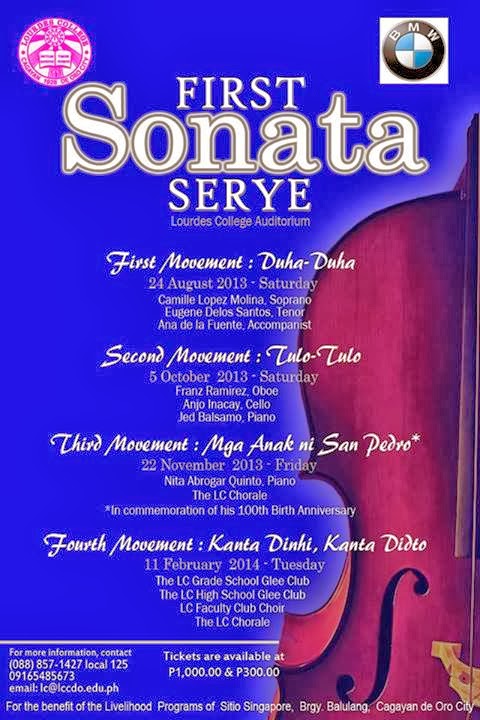
Second Movement of Sonata Serye continues at Lourdes College


October 5, 2013, 7:00 PM
Lourdes College Auditorium
Lourdes College, Cagayan de Oro

Featuring:
Franz Ramirez, oboe
Anjo Inacay, cello
Jed Balsamo, piano

The Lourdes College in Cagayan de Oro presents the Second Movement: Tulo-tulo of its first Sonata Serye on October 5, 2013, 7:00 PM at the newly-airconditioned Lourdes College Auditorium. This concert will feature oboist Franz Ramirez, cellist Anjo Inacay and composer-pianist Jed Balsadmo.

One of the highlights for this evening will be the debut performance of National Artists Lucio San Pedro and Levi Celerio’s Sa Ugoy ng Duyan for cello and piano arranged by Balsamo. The concert will also have the world premiere of ‘Da Nao by Gian Gianan who composed the music for Sapi, a film by Brillante Mendoza that recently premiered at the Toronto International Film Festival.

Franz Ramirez is the youngest principal player of the ABS-CBN Philharmonic Orchestra. Anjo Inacay, on the other hand, is the principal cellist of the Manila Symphony Orchestra and also a member of the band Silent Sanctuary. Born in Cagayan de Oro and now based in Manila, Jed Balsamo is currently the resident music director of Ballet Philippines. Lourdes College Music Department faculty member John Paul Cabelin and Ana dela Fuente, Chair of the Music Department, will be special guests for this evening.


The First Movement: Duha-duha featured Aliw-awardee soprano Camille Lopez-Molina, tenor Eugene de los Santos who is now Assistant Dean of the UST Conservatory of Music, and pianist Ana dela Fuente. Upcoming performances of the Sonata Serye include the Third Movement: Mga Anak ni San Pedro happening on November 22, 2013 to commemorate Lucio San Pedro’s centennial anniversary of his birth. This concert will feature pianist Nita Abrogar-Quinto and the LC Chorale. The Fourth Movement: Katha Dinhi, Kanta Didto happens on February 11, 2014 which will showcase the LC Grade School Glee Club, LC High School Glee Club, LC Faculty Choir and the LC Chorale.

The Sonata Serye, conceptualized by Jed Balsamo, is co-presented by BMW and Peugeot.

For inquiries:
(088) 857-1427 local 125, (0916) 548-5673, lc@lccdo.edu.ph